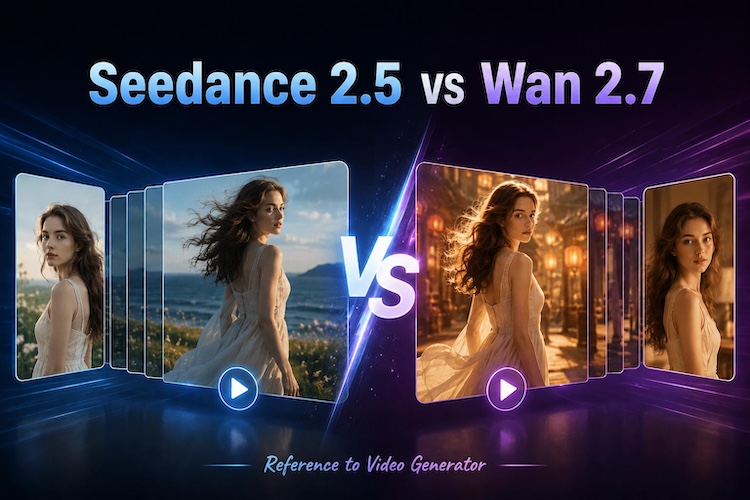
The race for AI video generation is accelerating, and AI reference to video has become one of the most exciting features available. Rather than relying solely on text prompts, creators can now guide AI with images, videos, and even audio to produce more consistent and controllable results. Both Seedance and Wan are among the strongest models in this space.In this guide, we compare Seedance 2.5 and Wan 2.7 on reference-to-video capabilities, creative controls, and output quality.
Seedance 2.5 and Wan 2.7: Key Differences at a Glance
While both engines are set to compete against each other, there are several capabilities that must be studied when selecting one. Let’s explore what each engine has to offer:
Seedance 2.5 Overview

Seedance is ByteDance’s latest family of AI video models, designed to produce cinematic videos with stronger prompt understanding and more controllable motion. Seedance 2.5 reference-to-video builds upon Seedance 2.0 with significant upgrades aimed at professional creators. According to its official announcement, Seedance 2.5 features include:
Seedance 2.5 Key Features
- Native reference-to-video generation
- Support for multiple image references
- Audio-guided video generation
- Instruction-based editing
- Up to 30-second video generation
- Support for as many as 50 reference elements
- Improved motion consistency
These improvements position Seedance as one of the strongest upcoming contenders for creators who require advanced production workflows.
Wan 2.7 Overview
Wan 2.7 reference-to-video is the latest release in Alibaba’s Wan AI video family and is already available for creators. The model focuses on accessible, high-quality video generation while offering strong reference fidelity and natural motion. Core capabilities include:
Wan 2.7 Key Features
- Image-to-video generation
- Character consistency
- Multi-reference support
- Prompt-guided editing
- High-resolution video outputs
- Faster generation times
- Broad availability through supported platforms
Wan 2.7 is widely used for advertising videos, social media content, product showcases, and cinematic AI storytelling.
Quick Comparison: Seedance 2.5 vs Wan 2.7
| Seedance 2.5 | Wan 2.7 | |
|---|---|---|
| Max Reference Inputs | Up to 50 (images, video, audio) | Up to 9 images + first/last frame control |
| Output Duration | Up to 30 seconds (single native pass) | Up to 15 seconds |
| Resolution | Native 4K | Up to 1080p |
| Native Audio | Yes (audio-video co-generated) | Yes (added in 2.7) |
| Character Consistency | Strong for single-subject and expressive motion | Strong for recurring characters across multiple clips |
| Prompt Adherence | Solid, but may interpret with creative license | Follows detailed descriptive prompts closely |
| Editing Control | Instruction-based + region-level editing | First/last frame, 9-grid, instruction-based editing |
| Availability | Enterprise beta; public launch July 2026 | Live now |
| Best For | Long-form cinematic content, branded storytelling | Controlled transitions, production pipelines, budget-conscious teams |
Seedance 2.5 vs Wan 2.7: Which Performs Better for Reference-to-Video?
This AI video model comparison focuses entirely on how each engine performs when using reference media instead of text-only prompts.


1 Supported Reference Inputs
First, let’s compare the supported reference input options among the two engines:
| Reference Inputs | Seedance 2.5 | Wan 2.7 |
|---|---|---|
| Text Prompts | ||
| Single/Multiple Images | ||
| Character References | ||
| Style References | ||
| Video Clips | ||
| Audio References |
Although highly capable, Wan 2.7 currently focuses primarily on visual references and does not offer the same native audio-reference workflow planned for Seedance 2.5.
2 Output Length and Resolution
One of the biggest differences lies in output duration.
Seedance 2.5
Seedance 2.5 is designed to generate videos up to 30 seconds in a single native pass at up to 4K resolution, making it well-suited for longer cinematic sequences, branded content, and storytelling.
Wan 2.7
Wan 2.7 currently prioritizes 15-second videos, highly polished clips that are ideal for advertisements, product showcases, and social media videos with up to 1080p resolution.
3 Prompt-Based Editing Control
Control over edits is one of the biggest differences between AI video models. While both engines allow users to guide generation with prompts, they approach editing differently.
Seedance 2.5
Seedance 2.5 introduces more advanced instruction-based editing. Users can provide detailed prompts to modify actions, camera movement, scene composition, or character behavior while preserving reference elements. This makes it especially useful for commercial productions, cinematic storytelling, and projects requiring multiple revisions.
Wan 2.7
Wan 2.7 also supports prompt-guided editing but emphasizes maintaining the original appearance of the uploaded reference. It performs particularly well when creators want subtle motion, consistent facial identity, or natural product animations without making dramatic changes.
4 Access and Availability
Both Seedance 2.5 and Wan 2.7 are now available through supported AI platforms, so access is no longer a major deciding factor. You can access both models in HitPaw Edimakor and choose the one that best fits your video creation needs.
Try Seedance 2.5 and Wan 2.7 in Edimakor:
How to Generate Reference-to-Video with Seedance and Wan 2.7
Instead of switching between multiple AI platforms, you can access powerful reference-to-video generation tools directly inside HitPaw Edimakor. The software currently supports Wan 2.7 and Seedance 2.0, with Seedance 2.5 integration planned in a future update.
Step 1: Download HitPaw Edimakor
Download and install the latest version of HitPaw Edimakor, then launch the software.
Step 2: Get Reference to Video
From the main dashboard, navigate to “AI Toolbox” and go to the “Video” tab to select “Reference to Video”. This workspace is specifically designed for generating videos from uploaded references.
Step 3: Choose the AI Model
Select your preferred AI video generation model. Current options include Seedance 2.5, Wan 2.7, Wan 3.0, and 10+ more AI models.
 You may also like:
Step 4: Add Reference Media
Upload your reference materials. Depending on your project, these may include: a reference video, portrait images, product photos and character pictures. Higher-quality references generally produce better and more consistent results.
Step 5: Enter Your Prompt and Generate
Describe the desired scene, camera movement, environment, lighting, and actions. Finish other settings and click “Generate” to create your AI video. After generation, you can further refine the video using Edimakor’s built-in editing tools.
How to Decide Between Seedance 2.5 and Wan 2.7
Choosing between these two models depends on your workflow rather than simply which engine is newer, since both are among the best AI video models of 2026 options.
Choose Wan 2.7 if you:
- Need results immediately.
- Prioritize strong visual reference fidelity.
- Create short-form advertising or social media content.
- Prefer an accessible workflow with proven performance.
Choose Seedance 2.5 if you:
- Plan to create longer narrative videos.
- Want support for audio-guided references.
- Need instruction-based editing for complex revisions.
- Work with multiple characters, products, or reference assets in a single project.
Both models are available in Edimakor, so you can choose the one that best fits your project. Use Wan 2.7 for fast, reference-focused generation, or choose Seedance 2.5 when you need longer videos and more precise creative control.
FAQs
A1: It is an AI technique that uses images, videos, or other reference media to guide video creation, producing more consistent and controllable results than text prompts alone.
A2: Currently, Wan 2.7 primarily supports visual references. Native audio-reference workflows are expected to be a key advantage of Seedance 2.5.
A3: Platforms like HitPaw Edimakor provide a graphical interface where you simply upload references, enter a prompt, choose an AI model, and generate videos—no coding or API setup required.
Conclusion
Wan 2.7 and Seedance 2.5 are designed for different video creation needs. Wan 2.7 is a practical choice for reference-to-video generation and fast content creation, while Seedance 2.5 offers longer outputs, multimodal controls, and more precise editing capabilities.
With both models available in HitPaw Edimakor, you can choose the right AI video model for your project and continue editing your generated videos in the same workflow. Try HitPaw Edimakor today and explore the latest AI video generation capabilities.
Leave a Comment
Create your review for HitPaw articles