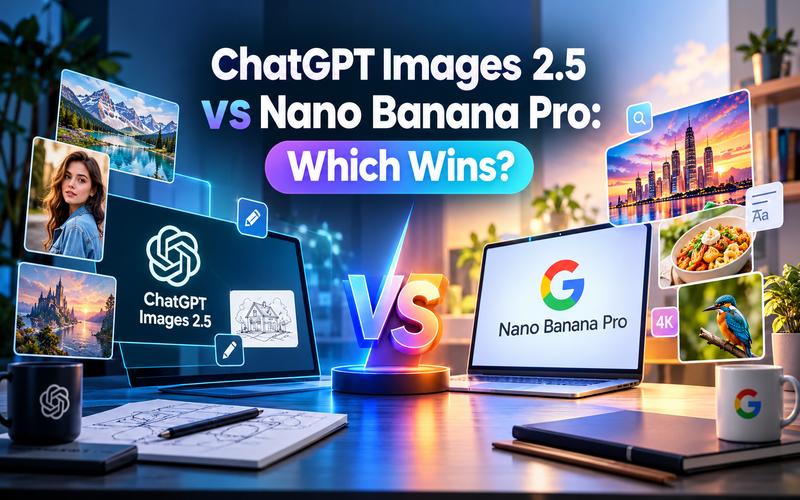
The battle for AI image supremacy has reached a new peak with the release of ChatGPT Images 2.5 and Google’s Nano Banana Pro. Both models promise studio quality visuals and unprecedented control over the creative process. Whether you are a professional designer or a casual creator, choosing between these two powerhouses requires a deep dive into their specific capabilities. This guide explores the “GPT Image 2.5 vs Nano Banana Pro” features, editing precision, and pricing to help you decide which one truly wins.
What Is GPT-Image-2.5?
ChatGPT Image 2.5 is OpenAI’s latest flagship image generation model, released on 8 September 2026. It represents a major leap from its predecessors, with sharper details, richer textures, and greater creative control. OpenAI designed this model to be “state of the art,” offering 50% lower latency than Images 2.0, which lets users refine concepts at nearly double the speed.
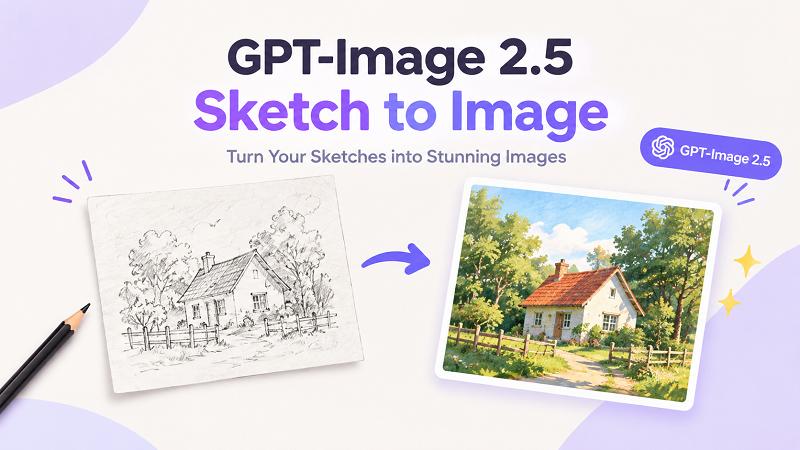
One standout feature of ChatGPT Images 2.5 is the “Sketch” tool. This lets users draw a rough layout or contour directly in the ChatGPT interface, and the model uses it as a structural guide to generate the final image.
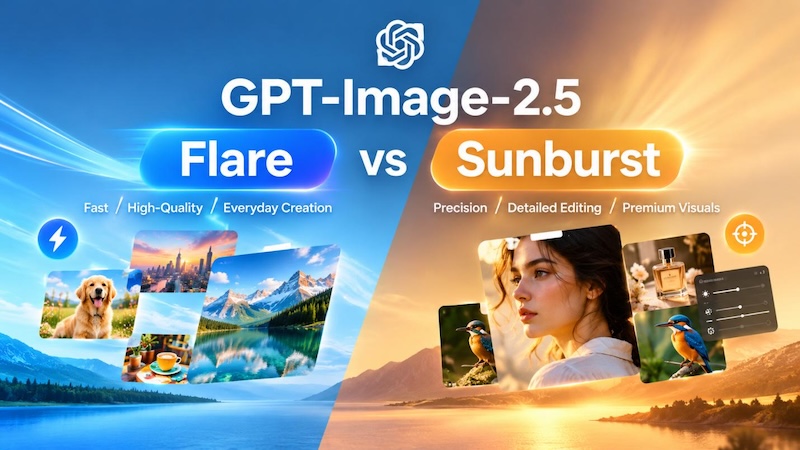
Additionally, the model introduces specialized templates for popular formats like posters and merchandise, making it easier for non-designers to achieve professional results. For developers, OpenAI offers two distinct API variants: Flare, optimized for speed and social content, and Sunburst, designed for premium, high precision creative work.
What Is Nano Banana Pro?
Nano Banana Pro, also known as Gemini 3 Pro Image, is Google DeepMind’s premier image generation and editing model. It is built on the robust Gemini 3 Pro architecture. It uses advanced reasoning and real world knowledge to create visuals that are not only beautiful but also contextually accurate. Google emphasizes its ability to visualize information, such as turning notes into diagrams or creating data rich infographics.
A defining characteristic of Nano Banana Pro is its deep integration with Google Search. This “Search grounding” lets the model pull in real time information like current weather, sports scores, or specific recipe facts to generate images that reflect the world as it exists today.
Furthermore, Nano Banana Pro supports up to 4K resolution and offers industry leading text rendering, allowing legible text in multiple languages and complex fonts. It also boasts a “consistency by design” feature that can blend up to 14 reference images while maintaining the likeness of up to five distinct people.
ChatGPT Images 2.5 vs Nano Banana Pro: Key Differences
While both models are world class, they cater to slightly different creative needs. ChatGPT Images 2.5 excels in workflow integration and rapid iteration, while Nano Banana Pro focuses on high-resolution output and information accuracy.
The following table summarizes the technical and functional differences between the two models.
| Feature | GPT Image 2.5 | Nano Banana Pro |
|---|---|---|
| Developer | OpenAI | |
| Max Resolution | Standard Web/Mobile | Up to 4K |
| Model family | GPT Image 2.5 | Gemini 3 Pro Image |
| Image generation | Yes | Yes |
| Image editing | Yes | Yes |
| Reference images | Subject Preservation Tools | Up to 14 images |
| Consistency | Multi-turn consistency | Up to 5 consistent people |
| Maximum advertised resolution | Depends on product/API workflow | Up to 4K |
| Text in images | Improved | Strong text rendering |
| Complex compositions | Yes | Designed for complex scenes |
| Speed | OpenAI reports up to 50% lower latency than Images 2.0 | Nano Banana Pro site reports 10–30 seconds for 4K |
| Access | ChatGPT and API | Gemini/API and third party platforms |
| Best fit | Iterative editing and controlled changes | Complex, detailed, high resolution visuals |
| Special Features | Sketch, Templates, Comments | Search Grounding, 4K, Multi turn editing |
| Text Rendering | Improved coherence | Multilingual, legible long text |
| Editing Control | Precise localized editing | Lighting (day/night), Bokeh, Focus |
| Watermarking | C2PA, Invisible Watermarks | SynthID (can be verified by Gemini) |
| Grounding | Internal Knowledge | Google Search Grounding |
The “GPT Image 2.5 vs nano banana pro” choice often comes down to whether you need Google's real-time data or OpenAI's creative workflow tools.
Precise Image Editing Comparison
Both models offer advanced editing suites, but they approach user control differently. ChatGPT Images 2.5 introduces “focused editing,” where users can place comments directly on an image to request specific changes. The Sketch feature further enhances this by giving the model a visual reference to follow.
In contrast, Nano Banana Pro offers “localized editing,” allowing users to select and transform specific parts of an image with studio level precision. It also gives users control over camera angles, depth of field, and lighting effects, such as transforming a daytime scene into a nighttime one while maintaining the original features of the subjects.
Test Case: Modifying a Detailed Subject
Source Image: A professional portrait of a woman wearing a red jacket in a park.

“Change the red jacket to a blue denim jacket while keeping her facial expression and the background the same.”
- ChatGPT Images 2.5 Performance (Expected): The model excels at preserving the subject’s identity and the overall composition. Its multi-turn consistency ensures a smooth transition from red to blue, and the “focused editing” lets the user pinpoint the jacket area for the change.
-
Nano Banana Pro Performance (Expected):
Using its localized editing tool, Nano Banana Pro can isolate the jacket texture. Its reasoning driven engine ensures the folds and shadows of the denim look natural under the existing park lighting.
Assessment: Both models perform excellently in this task. ChatGPT Images 2.5 is more intuitive for users who prefer a conversational interface, while Nano Banana Pro offers more granular control for professional designers.
Image Quality and Detail Comparison
We use a highly complex prompt with multiple textures to test the limits of fine-detail rendering.
“A striking close up portrait of an elderly artisan in a warmly sunlit workshop. Detailed skin texture with visible pores and wrinkles, individual silver hair strands, a linen apron with visible fabric weave, and intricate gold jewelry with small engraved patterns. In the background, dusty wooden shelves with small glass jars.”
- ChatGPT Images 2.5 Result: OpenAI’s model is specifically noted for “sharper details” and “more natural lighting”. In this scenario, we expect it to produce rich textures on the linen and skin, with a focus on a “recognizable” and grounded subject that feels like a real life memory.
-
Nano Banana Pro Result:
Google’s model uses its Gemini 3 reasoning to understand the “depth and nuance” of the scene. It is likely to render the engraved jewelry patterns with high precision and ensure the text on the jars (if requested) is perfectly legible. Its 4K output provides a higher ceiling for fine grain detail in print ready files.
Assessment: ChatGPT Images 2.5 provides a warmer, more “natural” feel that is best for artistic projects. Nano Banana Pro is superior for high resolution professional outputs where technical accuracy and legible details are paramount.
Generation Speed and Pricing Comparison
Speed and cost are critical for both individual creators and enterprise teams. OpenAI has made speed a core selling point for ChatGPT Images 2.5. By reducing latency by 50% compared to version 2.0, it lets users iterate through concepts quickly. For high volume production, the “Flare” model in the API is built specifically for this type of rapid prototyping. Nano Banana Pro’s speed isn’t quantified the same way, but the Gemini app offers a “Thinking” model that focuses on complex results rather than instant generation.
Consumer Access and Quotas
OpenAI makes ChatGPT Images 2.5 available to all users across all tiers. Google provides limited free quotas for Nano Banana Pro in the Gemini app; after users exhaust them, they revert to the original Nano Banana model. Higher quotas are reserved for Google AI Plus, Pro, and Ultra subscribers.
API Pricing
API costs differ between the two providers. Google bills primarily per image for the Gemini API, while OpenAI uses a token-based system for its new Flare and Sunburst models.
-
Google Gemini API (Nano Banana Pro):
- Image Input: $0.0011 per image (560 tokens).
- 1K/2K Output: Approximately $0.134 per image (1,120 tokens).
- 4K Output: Approximately $0.24 per image (2,000 tokens).
-
OpenAI API (Flare & Sunburst):
- Image Input: $8.00 per 1 million tokens.
- Cached Input: $2.00 per 1 million tokens.
- Image Output: $30.00 per 1 million tokens.
Note that OpenAI’s total cost per image depends on the specific resolution and token consumption, making a direct price comparison with Google’s per-image figures difficult without a specific use case calculation.
When to Choose ChatGPT Images 2.5
ChatGPT Images 2.5 may fit your workflow when you need:
- Precise edits to existing images
- Strong preservation of subjects and compositions
- Multi-turn image refinement
- Fast everyday image generation
- Creative work directly inside ChatGPT
- Sketch based visual ideas
- Transparent background and layout focused workflows
OpenAI specifically highlights precision editing, multi turn consistency, reference image fidelity, and faster generation as major improvements in Images 2.5.
When to Choose Nano Banana Pro
Nano Banana Pro may fit your workflow when you need:
- Complex visual compositions
- Professional creative assets
- Detailed text inside images
- High resolution outputs
- Advanced image editing
- Real world information through Google Search grounding
- Product mockups and structured visual designs
Google positions Nano Banana Pro for professional asset production and complex instructions, including designs that require accurate text and real-world grounding.
Try GPT Image 2.5 and Nano Banana Pro in One Platform
Edimakor AI is a powerful option for users who want to try different AI image models without switching between multiple platforms. It provides a centralized hub where you can access 10+ AI models in a single browser based interface. This eliminates the need for multiple subscriptions and enables easy side by side comparison. It streamlines video and image creation, making it easy to test different styles in one place.
The workflow is simple:
Step 1: Open the Edimakor AI and select the “Text to Image” or “Image to Image” tool.
Try It Online
Step 2: Enter your “prompt” or upload the image you want to edit. Then select the “model” that best fits your project and adjust the image settings like resolution and aspect ratio as needed.
Step 3: Click “Generate” to view your results instantly, and use the built-in effects to refine your image further or animate it into a video.
This approach can make model testing easier because you can compare different generation options without rebuilding your workflow from scratch.
FAQs about GPT Image 2.5 Vs Nano Banana Pro
A1: Yes, both ChatGPT Images 2.5 and Nano Banana Pro are integrated into professional tools like Adobe Firefly and Google Ads for commercial use. However, Edimakor AI users should note that paid plans are required to remove watermarks for branded content.
A2: OpenAI uses C2PA metadata and invisible watermarks. Google uses SynthID, which lets users upload an image to the Gemini app to verify whether Google AI generated it.
A3: Nano Banana Pro is specifically highlighted for its ability to generate and translate text in multiple languages accurately within the image.
Conclusion
The choice between GPT Image 2.5 and Nano Banana Pro ultimately depends on your specific creative needs. OpenAI offers a fast, conversational, and highly consistent experience best for rapid prototyping. In contrast, Google provides professional studio controls and superior text handling for finished design assets. Instead of choosing a single winner, test both with your own prompts. Try Edimakor AI to explore different AI image models in one platform and find the workflow that fits your projects.


Leave a Comment
Create your review for HitPaw articles